
Who Are the Top Biomass Leather Manufacturers in China?
Biomass Leather is gaining attention as Chinese manufacturers develop materials using agricultural residues, plant fibers, and other renewable inputs. Yet the label alone tells buyers very little. Feedstock, binder chemistry, coating, and production methods can vary widely, even between products that look similar. A sample may feel supple under a fingertip but crack after repeated folding. Details matter.
Materials scientist Dr. Richard P. Wool’s research on bio-based composites offers a useful principle: renewable ingredients must be assessed alongside durability and end-of-life considerations. That is a paraphrase of the practical lesson from his work, not a direct quotation. For buyers comparing Chinese suppliers, evidence should include material composition, test methods, batch consistency, and clear performance data. Ask how the product handles abrasion, moisture, and heat. Request supporting documents, not just attractive swatches.
This guide looks at manufacturers through those practical questions. It considers their disclosed feedstocks, product applications, manufacturing capabilities, and available technical evidence. Company claims still deserve scrutiny. A polished sample is not enough. Some suppliers may share limited public data, and “plant-based” does not mean fully plant-derived. Those gaps should be acknowledged, not glossed over. The aim is to help readers identify promising Biomass Leather makers while distinguishing verifiable information from marketing language. A careful shortlist is more useful than a confident ranking built on incomplete evidence.
What Biomass Leather Is and How It Is Made
Biomass leather describes sheet materials made partly from biological sources, such as crop residues, plant oils, fungal growth, or bacterial cellulose. Despite the name, it is not always animal hide, and “biomass” does not mean every component is plant-based. Some products also contain textile backing, synthetic binders, or protective coatings. The details matter.
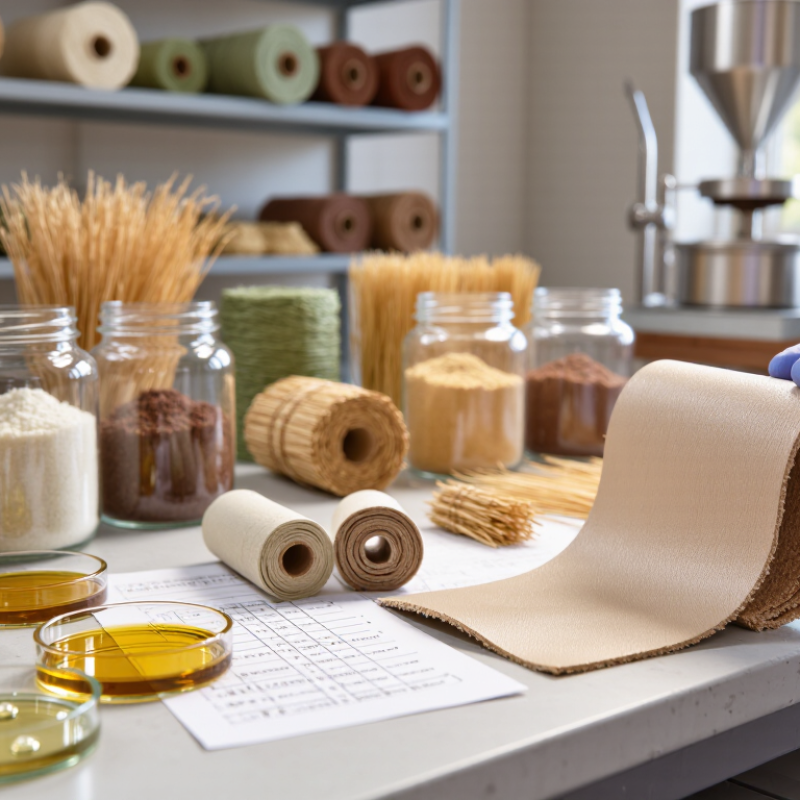
Production varies with the raw material. Plant residues may be cleaned, dried, and ground into fibers or powder. These ingredients can be mixed with binders, spread onto a fabric backing, then pressed and dried into sheets. Other methods grow fungal networks or cellulose into a structure before shaping and finishing it. A finished surface may receive embossing, color, or a water-resistant coating. Small surface details can reveal a lot.
For buyers, useful questions include how much of the material comes from biomass, what provides its strength, and how it performs after repeated bending. A soft hand feel is encouraging, but it does not prove long-term durability. I would also avoid treating “bio-based” as a complete environmental assessment; sourcing, processing, coatings, and end-of-life options all matter. The category is promising, but its claims deserve careful checking.
| Topic | Material or Production Detail | What Can Be Reliably Said |
|---|---|---|
| Manufacturer rankings | Publicly verifiable ranking of Chinese biomass-leather manufacturers | A consistent, independently verified ranking is not established here. Ranking producers would require comparable evidence, such as audited production volumes, product specifications, and independently verified bio-based content. |
| Meaning of “biomass leather” | A broad label for leather-like materials made partly from biological or plant-derived resources | The term does not identify one standardized material or guarantee that a product is entirely bio-based. Formulations and the proportion of biomass vary by product. |
| Plant-residue feedstocks | Examples used in material development include agricultural or food-processing residues such as fruit pomace and leaf fibers | Residues may be processed into fibers, powders, or other components. Their use does not, by itself, establish a product’s overall environmental impact or its percentage of bio-based content. |
| Mycelium-based materials | Fungal mycelium grown into a sheet-like structure | After growth, the material can be harvested and processed. The finished product may receive treatments or coatings, so the final composition depends on the specific product. |
| Bacterial-cellulose materials | Cellulose produced by certain bacteria during fermentation | The resulting cellulose can be formed into a film or sheet and further processed. Additional ingredients, backing materials, or coatings may be used in finished goods. |
| Typical composite construction | Biomass-derived component, binding system, backing, and surface finish | Some leather-like materials combine biomass with polymers such as polyurethane (PU) and a textile backing. The presence of biomass does not mean the entire composite is biodegradable or plastic-free. |
| General manufacturing sequence | Feedstock preparation → forming or blending → sheet formation → finishing | Depending on the feedstock, steps may include cleaning, drying, grinding, fiber extraction, fermentation or cultivation, blending with binders, forming a sheet, and applying a finish. Not every product uses every step. |
| Performance considerations | Durability, flexibility, abrasion resistance, water resistance, and consistency | Performance must be assessed on the finished material using appropriate test methods. It cannot be inferred from the feedstock name alone. |
| How to evaluate a Chinese supplier | Request a technical data sheet, sample, composition disclosure, and test reports | Confirm the stated bio-based content and how it was measured; identify the backing, binder, and coatings; and request relevant durability and chemical-compliance documentation for the intended application. |
| Key takeaway | Biomass leather is a category, not a single recipe | To compare manufacturers fairly, use product-level evidence and clearly defined criteria rather than relying on the “biomass leather” label alone. |