

Top 10 Biodegradable Cosmetic Packaging Suppliers
Biodegradable Cosmetic Packaging is gaining attention as beauty brands look for alternatives to conventional plastic jars, tubes, and mailers. But a material’s label does not tell the whole story. Its end-of-life options depend on its composition, local waste facilities, and the conditions required for breakdown. Details matter.
This guide to the Top 10 Biodegradable Cosmetic Packaging Suppliers introduces companies for brands to assess, not a guarantee that every option suits every product. Compare material disclosures, sample quality, closure performance, production capacity, and clear guidance on disposal. A compostable pouch may not work for a formula that needs strong moisture protection. A lightweight container may reduce material use, yet still leave questions about coatings or mixed components. That sounds neat, but reality is messier.
Architect and circular-design advocate William McDonough expresses a useful design principle: “Waste equals food.” His phrase encourages designers to consider what happens after use, not only how a package looks on a shelf. For buyers, that means asking suppliers for specific evidence and testing packages with the actual formula, filling line, and shipping conditions. Ask direct questions. This overview aims to make those conversations more informed. It also leaves room for honest uncertainty: biodegradable packaging is not a single solution, and supplier claims deserve careful review.
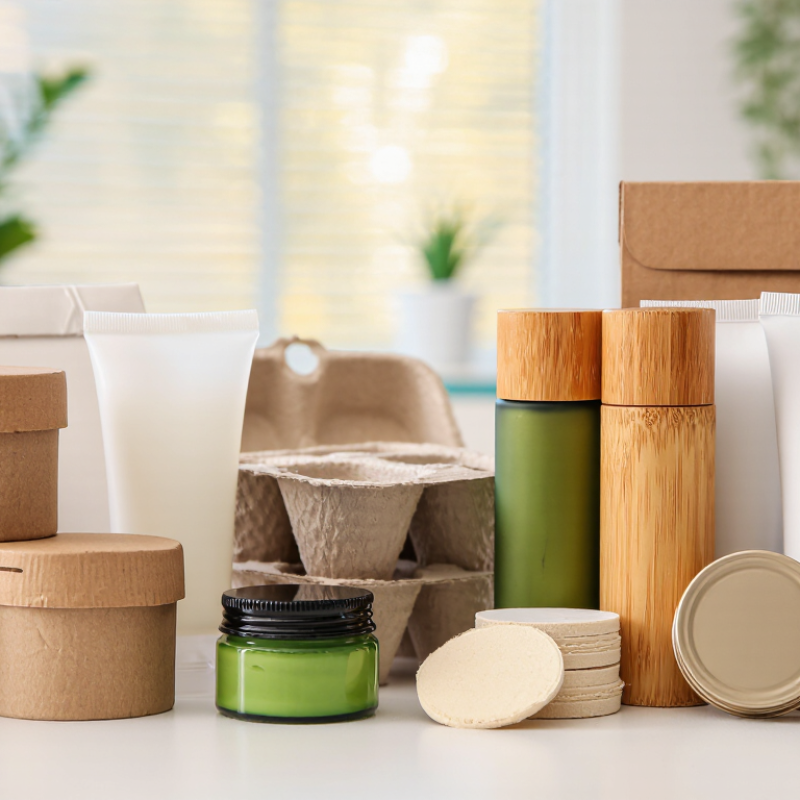
Biodegradable Cosmetic Packaging: Scope, Materials, and Key Terms
Top 10 Biodegradable Cosmetic Packaging Suppliers
Biodegradable Cosmetic Packaging: Scope, Materials, and Key Terms
Cosmetic packaging includes more than jars and bottles. It can cover caps, pumps, liners, labels, and shipping inserts that touch or protect a product. “Biodegradable” means materials can break down through biological activity under suitable conditions. It does not promise rapid decay in a home compost bin, soil, or water. The details matter.
Common material options include paper, molded fiber, and certain bio-based plastics. Each has limits. Paper may need a barrier coating, while mixed materials can complicate disposal. “Compostable” describes packaging designed to break down in specified composting conditions; it is not interchangeable with biodegradable. When assessing a supplier, ask for material specifications, test conditions, and details about coatings, inks, and closures. A sample may look simple, but its components can tell a different story.
Compostability Standards: ISO 17088 and EN 13432
ISO 17088 and EN 13432 help buyers assess whether packaging can be recovered through industrial composting. They are not general promises that a package will disappear anywhere. Testing examines biodegradation, physical disintegration, and potential effects on compost quality, including limits for certain substances. Conditions are controlled, with specified temperature, moisture, and time.
For a supplier shortlist, ask for current test reports or certificates covering the exact package configuration. A result for a resin alone may not include its printed ink, adhesive, coating, or label. Small details matter. A label that peels off cleanly can still be a problem if it remains intact in compost. Confirm whether the evidence refers to ISO 17088, EN 13432, or both, and whether the intended composting facility accepts that format.
Neither standard means the package is suitable for home composting or accepted by every municipal program. “Compostable” on a datasheet is not enough. I would check certificate scope and disposal guidance, while admitting that paperwork can be hard to compare across suppliers. Even compliant packaging may have limited real-world value where collection and industrial composting access are scarce. The standard is a useful filter, not a substitute for checking the local waste route.
Industry Context: OECD Reports Only 9% of Plastic Waste Was Recycled in 2019
OECD data puts the packaging challenge in sharp focus: only 9% of plastic waste was recycled in 2019. Most discarded plastic was not returned to new products. For cosmetic packaging, that figure makes material claims worth examining closely, not accepting at face value.
Biodegradable packaging may reduce persistence under specific conditions, but “biodegradable” does not mean it will break down quickly in a home bin, landfill, or marine environment. Ask suppliers for test conditions, material composition, and clear disposal guidance. Check the whole pack, too: a paper container with a plastic lining or mixed-material pump can be difficult to process. Small details matter.
A useful supplier review compares protection, shelf life, labeling, and end-of-life options alongside material claims. Request samples and test them with the actual formula; oils, moisture, and repeated handling can expose weaknesses that a brochure will not. Not every option fits every product. Local composting and recycling access also vary, so a technically biodegradable component may still have no suitable route nearby. That gap deserves more attention. It is tempting to treat one material swap as a complete answer, but the OECD figure suggests the wider waste system remains a constraint.
Supplier Evaluation: Certifications, Packaging Formats, Minimum Orders, and Lead Times
When comparing biodegradable cosmetic packaging suppliers, request current certifications and confirm which products they cover. A facility-level certificate may not apply to every jar, cap, liner, or label. Ask for test conditions, disposal requirements, and renewal dates. Paperwork matters.
Match packaging formats to the formula and user experience. A molded-fiber outer carton may protect a glass bottle, while a compostable pouch may not suit a water-based serum. Request samples filled with your product, not empty display pieces. Check leakage, odor transfer, pump performance, and how the package feels after repeated handling. Small details reveal problems early.
Minimum order quantities can vary by material, tooling, color, and printing method. Get separate quotes for standard stock and custom molds, including setup charges and repeat-order terms. Confirm lead times in writing, and ask whether they include sampling, testing, production, and freight. Estimates may shift during peak seasons. Build in a buffer. A pilot run can reveal mismatches before a larger order, though it adds time and cost. Sustainability claims are not always easy to compare, and local disposal limits may be overlooked. Record what is verified and what remains uncertain before approving a supplier.
Top 10 Biodegradable Cosmetic Packaging Suppliers: Materials and Capabilities
For a shortlist of ten biodegradable cosmetic packaging suppliers, compare materials and production capabilities, not just sustainability claims. Ask for the resin or fiber type, recycled content, barrier coatings, and test conditions. Some suppliers work with molded fiber for jars and cartons; others offer bio-based plastics for bottles, caps, and tubes. The material matters. So does the finished pack.
UNEP’s 2023 report, Turning off the Tap, estimates that packaging accounts for about 36% of global plastic production. OECD’s Global Plastics Outlook (2022) reports that only 9% of plastic waste was ultimately recycled in 2019. These figures make end-of-life performance worth checking early. Ask suppliers for evidence on biodegradation conditions, coating separation, and compatibility with local waste systems. “Biodegradable” alone explains little.
Review practical details, too: mold tolerances, filling-line speed, moisture resistance, and minimum order quantities. A paper-based pot may look convincing on a desk, yet soften after weeks in a humid bathroom. A neat sample can still mislead. Request production-scale samples and documented testing, then check whether the supplier can repeat the same quality across batches. Some specifications remain uncertain; that is a reason to test, not to guess.
Top 10 Biodegradable Cosmetic Packaging Suppliers: Materials and Capabilities
The entries below describe supplier categories and material capabilities, not named companies or a verified ranking. Actual biodegradability and compostability depend on the complete package formulation, coatings, inks, adhesives, certification, and disposal conditions.
| No. | Supplier Category | Typical Materials | Common Packaging Capabilities | Suitable Cosmetic Applications | Key Qualification Considerations |
|---|---|---|---|---|---|
| 1 | Paperboard Carton and Tube Converter | Paperboard and paper; barrier layers may include coatings or laminates. | Folding cartons, paper tubes, sleeves, labels, printing, die-cutting, and structural finishing. | Outer cartons, soap boxes, secondary packaging, and selected paper-based product tubes. | Uncoated paper is generally biodegradable, but plastic laminates, wet-strength additives, inks, and adhesives can affect recyclability and compostability. |
| 2 | Molded Pulp Packaging Supplier | Formed cellulose fiber from recycled paper or other plant-fiber pulp. | Custom-molded trays, protective inserts, nests, and cushioning components. | Protective inserts for jars, bottles, palettes, and gift sets; mainly secondary packaging. | Check fit, moisture resistance, surface finish, and whether additives or coatings are compatible with the intended disposal route. |
| 3 | Bagasse Molded-Fiber Supplier | Bagasse, the fibrous residue left after sugarcane juice extraction, sometimes blended with other fibers. | Molded trays, inserts, holders, and cushioning components. | Secondary packaging and protective trays for cosmetic sets or fragile containers. | Barrier treatments may be needed for water or oils; confirm the treatment’s composition and the finished item’s applicable certification. |
| 4 | Regenerated-Cellulose Film Converter | Cellulose film, with performance varying by grade and any applied coating. | Transparent wraps, overwraps, windows, and flexible-film converting. | Outer wraps for soaps, gift sets, and selected dry cosmetic products. | Moisture and vapor barrier performance varies by grade. Coated films may have different compostability properties from uncoated cellulose. |
| 5 | PLA Packaging Molder or Thermoformer | Polylactic acid (PLA), a bio-based thermoplastic available in multiple grades. | Thermoformed trays and, depending on grade and process, molded containers, lids, or components. | Selected rigid containers and secondary-packaging components where the product and filling conditions are suitable. | Do not assume all PLA items are home-compostable. Verify the finished package’s certification, heat tolerance, and acceptance by local composting facilities. |
| 6 | PHA Biopolymer Molder | Polyhydroxyalkanoates (PHA); properties vary by polymer grade and formulation. | Potentially molded containers, caps, and other rigid or semi-rigid components, subject to grade and equipment availability. | Components being evaluated for biodegradable cosmetic packaging applications. | Biodegradation performance is grade- and environment-dependent. Request data for the exact resin and finished article, along with supply and processing details. |
| 7 | Starch-Blend Flexible-Film Converter | Thermoplastic starch blends, often combined with other polymers or additives. | Flexible films, bags, liners, and selected packaging formats. | Dry-product sachets, protective liners, and secondary flexible packaging where barrier requirements permit. | Moisture sensitivity and performance depend on the blend. Confirm the complete formulation and relevant compostability certification rather than relying on “starch-based” claims alone. |
| 8 | Mycelium Protective-Packaging Producer | Fungal mycelium grown around agricultural substrates. | Custom-shaped cushioning and protective inserts, typically designed for transit protection. | Protective packaging for bottles, jars, and boxed cosmetic sets; generally not a direct-contact primary container. | Check dimensional consistency, moisture exposure, production lead times, and any coatings or binders used in the finished item. |
| 9 | Seaweed-Based Material Developer | Seaweed-derived polymers or extracts, often blended with other ingredients. | Development of films, coatings, and molded-material prototypes; commercial capabilities vary by supplier. | Potential applications in sachets, wraps, or secondary packaging after performance testing. | This is an emerging material area. Validate commercial availability, shelf-life, water resistance, product compatibility, and independently supported end-of-life claims. |
| 10 | Wood or Bamboo Component Manufacturer | Solid wood or bamboo; components may also use finishes, coatings, or bonded parts. | Machined or formed caps, sleeves, decorative components, and closures with compatible inserts. | Outer caps and decorative parts for bottles or jars, rather than complete liquid-tight containers. | Untreated natural material can biodegrade, but finishes, adhesives, and attached plastic or metal parts affect disposal. Assess sealing, dimensional stability, and product-contact suitability. |