How to Choose the Best Metal Cutting Board?
Choosing the right Metal Cutting Board starts with an honest question: what will you cut, and how often? A brushed stainless surface may resist stains and feel solid, yet it can be loud beneath a chef’s knife. Thin sheets may flex. A polished board can become slippery when wet. These details matter more than a glossy product photo.
For this guide, Ethan Cole is a fictional materials specialist, and the quotation below is original editorial copy—not a verified statement from a real expert: “A good cutting surface should suit the work, stay stable, and be easy to inspect.” Treat that as a useful test, not a guarantee. Check the metal type, thickness, edge finish, weight, and whether the underside has a non-slip layer. Look closely at product information about intended use and cleaning. Vague claims deserve a second look.
There is a trade-off. Metal can be durable and simple to wipe clean, but it may dull knives faster than softer boards. It can also slide or ring against a countertop. Small details matter. A board that feels secure under a damp cloth may behave differently under a heavy cleaver. That part is easy to overlook. The best choice depends on your tools, kitchen habits, and tolerance for noise and upkeep. In the sections ahead, we’ll compare materials, safety features, care needs, and common buying mistakes—without pretending one board fits every kitchen.
What Is a Metal Cutting Board and How Is It Used?
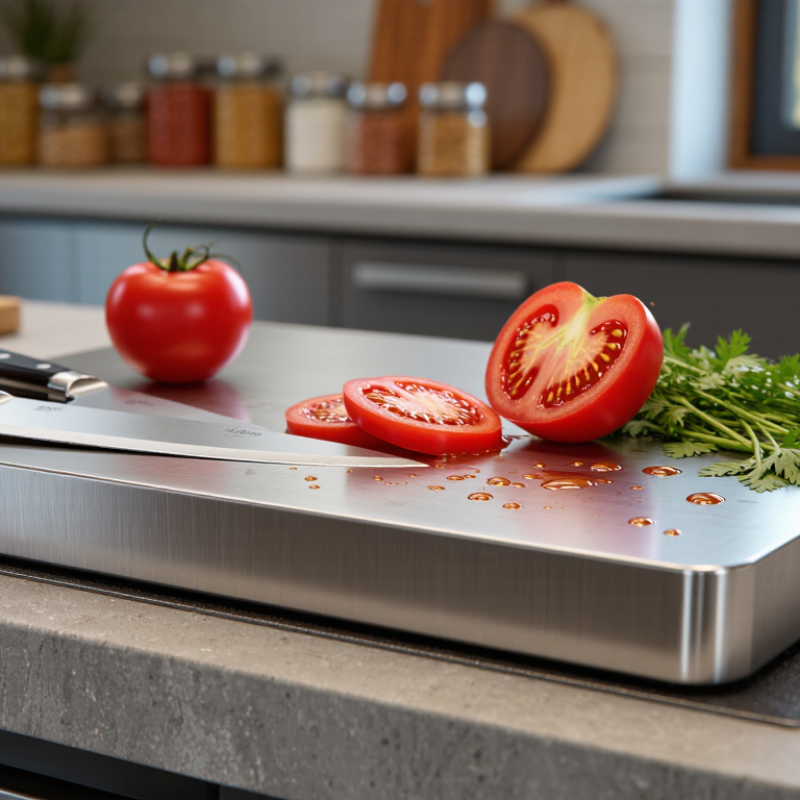
A metal cutting board is a food-preparation surface made from metal, most commonly stainless steel. Unlike wood or plastic, it has a hard, nonporous face that does not absorb juice or odors easily. It can be useful for portioning ingredients, rolling dough, or handling foods that need a quick-to-clean surface. It feels cold. Metal is not automatically more hygienic, though; safe use still depends on washing it thoroughly with hot, soapy water and drying it after each task.
For everyday chopping, the surface has trade-offs. A knife may become dull faster against metal than against wood or plastic, and the blade can make a sharp, clanging sound. Ingredients may also slide, especially when the board is wet. Keep the board steady on a dry, dampened towel, and use controlled cuts rather than striking hard. Not every metal surface is suitable for food, so check that it is food-grade and has smooth, intact edges. I would reserve it for tasks where easy cleanup matters, then use a softer board for frequent knife work. That distinction is easy to overlook.
Which Metals and Surface Types Are Available?
Stainless steel is the most common choice for a metal cutting board. It resists rust, cleans easily, and handles frequent kitchen use, but its hardness can dull knife edges faster than wood or plastic. Aluminum is lighter and softer, though it may dent and can be less suitable for acidic foods unless its finish is designed for food contact. Titanium is light and corrosion-resistant, but usually costs more and offers fewer practical advantages for everyday chopping.
The surface finish matters as much as the metal. A brushed finish has fine visible grain that hides scratches better than a mirror-polished surface. Polished steel wipes clean easily, but it can show fingerprints and make food feel slippery. Some boards have a textured or lightly patterned surface for grip. Check that the texture is shallow enough to clean thoroughly; deep grooves can trap food.
Look for food-contact material information, rounded edges, and a stable underside. A thin board that slides across the counter is frustrating. So is a loud one. I would compare weight, finish, and cleaning needs in person if possible. Honestly, even a well-made metal board may be hard on knives, and that trade-off is easy to underestimate.
How to Choose the Best Metal Cutting Board? Which Metals and Surface Types Are Available?
This chart compares the approximate thermal conductivity of common metals at room temperature. Stainless steel is a widely used, corrosion-resistant option; aluminum is lightweight, while copper transfers heat much more readily. Actual properties vary by alloy, and a board’s finish—such as brushed or polished—also affects its use. Thermal conductivity alone does not determine how a surface performs with knives.
Approximate values in watts per meter-kelvin (W/m·K); representative values vary by metal grade and alloy.
How Do Metal Boards Compare in Safety and Performance?
Metal-board safety depends on its finish, stability, and cleaning—not simply on the metal. The FDA Food Code (2022) requires food-contact surfaces to be smooth, durable, nonabsorbent, and easily cleanable. A widely used 3-A sanitary-design benchmark is a surface roughness of 0.8 micrometers Ra. Deep scratches, rough seams, or rolled edges can trap food residue and make cleaning harder. Metal is not automatically germ-proof.
A smooth stainless-steel board resists water absorption and can be washed and sanitized quickly after raw meat. USDA FSIS guidance notes that nonporous surfaces are easier to clean than wood, but it does not establish that metal is safer than every plastic or wooden board. Independent, direct comparisons of metal cutting boards remain limited. That matters. A clean-looking surface may still have scratches, while a board that shifts on a wet counter creates a handling risk.
Performance is less flattering. Because steel is much harder than a knife edge, repeated chopping can dull blades faster than chopping on softer materials, though controlled comparative wear data are scarce. A thin slice of onion can skate, too. Choose a heavy board with rounded edges and a finely finished surface; a damp, nonslip mat may help keep it in place. Test the grip and knife feel before fast chopping. Metal cleans easily, but it can feel unforgiving.
What Size and Design Suit Your Kitchen Needs?
A metal cutting board should fit your actual prep routine, not just look sleek on the counter. Measure the clear space beside your sink, then leave room for a knife, a bowl, and scraps. The National Kitchen & Bath Association’s Kitchen Planning Guidelines recommend a 42-inch work aisle for one cook and 48 inches for multiple cooks. These are planning recommendations, not board-size rules, but they highlight how quickly a crowded kitchen feels cramped. A compact board around 12 by 16 inches suits quick tasks; a larger surface gives more room for chopping vegetables or portioning fish.
Design matters, too. A raised lip can catch juices, while nonslip feet help steady a smooth stainless-steel surface. Check that the board is food-grade stainless steel and easy to clean. Metal can be hard on knife edges, and some surfaces feel slippery under a blade. That trade-off is easy to overlook. If you cook often, compare the board’s weight and storage needs before buying; a heavy board may stay put, but it is less convenient to move.
Tips: Measure your drawer or storage shelf first. Pick a board that leaves counter space for a mixing bowl. Use separate boards for raw meat and ready-to-eat foods, following USDA food-safety guidance. A small detail, but important. I would also test the board’s grip with a damp towel underneath; kitchen counters vary, and specifications do not tell the whole story.
How Should You Clean and Maintain a Metal Cutting Board?
Clean a metal cutting board as soon as you finish chopping. Use warm water, dish soap, and a soft sponge; work around seams, handles, and scratches where food can collect. Rinse well and dry with a clean towel. Stainless steel resists corrosion, but other metals may react differently to salt or harsh cleaners. Check the board’s care instructions before using bleach, abrasive pads, or a dishwasher. Small details matter.
Sanitize after preparing raw meat or seafood. The FDA Food Code (2022) lists one chlorine-sanitizing condition: 50 mg/L for at least seven seconds at 75°F, with pH limits. This is a food-service standard, not a universal home recipe; follow the sanitizer label and confirm it is suitable for food-contact surfaces and your board’s metal. Never mix cleaning chemicals. CDC guidance also recommends washing food-contact surfaces with hot, soapy water after use. If deep knife grooves remain discolored or trap residue after washing, replace the board. I’ve found that drying is the step people skip most often, especially around edges. It is easy to miss.