

China Top 10 Floating Mat Manufacturers for Global Buyers
The global market for recreational water products is becoming more quality-conscious. Buyers now examine material strength, production consistency, safety testing, and after-sales support before placing large orders. The National Marine Manufacturers Association reported that about 85 million Americans went boating in 2023. This participation level shows the continuing demand for practical water recreation products, including the Floating Mat.
Yet supplier selection is not simply a price comparison. A reliable manufacturer should understand drop-stitch construction, reinforced seams, load distribution, storage conditions, and surface grip. These details become obvious when a mat is used on a sunny lake, beside a resort dock, or under repeated boarding pressure. ISO 25649 provides safety requirements and test methods for floating leisure articles used on or in water. Its framework offers a useful reference for global buyers assessing product design and testing discipline.
This guide presents China’s top 10 Floating Mat manufacturers for international buyers. The selection considers factory capability, customization, export experience, quality controls, product range, and communication reliability. Public company information and industry references support the comparison, although supplier data is not always equally transparent. That limitation matters.
Some factories show impressive catalogs but provide limited test documentation. Others offer excellent prototypes yet lack stable mass-production evidence. Buyers should verify certificates, sample performance, packaging details, and warranty terms directly. Grand View Research and other market analysts continue to highlight rising interest in inflatable and outdoor recreation products, but broad market figures cannot guarantee one supplier’s performance. Real inspection still matters.
The companies below may suit distributors, water parks, resorts, event organizers, and marine leisure brands. A careful shortlist can reduce avoidable risks. Still, no ranking replaces independent due diligence.
Floating Mat Manufacturing in China: Industry Scope and Product Types
China Top 10 Floating Mat Manufacturers for Global Buyers
China’s floating mat manufacturing sector covers recreational, commercial, and modular water platforms. The industry benefits from China’s broad polymer, textile, welding, and tooling supply chains. UNIDO’s International Yearbook of Industrial Statistics 2024 reports that China contributed about 31.6% of global manufacturing value added in 2022. This capacity supports flexible production for overseas buyers.
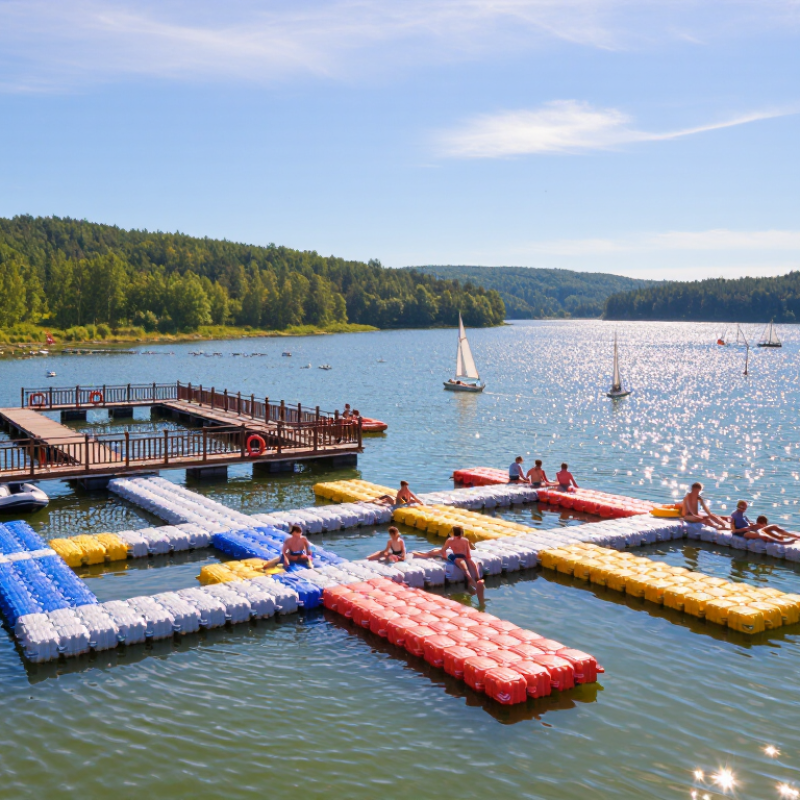
Product types vary by material and application. EVA foam mats provide buoyancy, cushioning, and simple roll-up storage. Inflatable PVC platforms offer lower shipping volume but require careful seam inspection. Modular floating docks use interlocking plastic sections, often with textured surfaces and reinforced connection points.
Commercial buyers may also request swim platforms, water play areas, exercise mats, or customized event flooring. Grand View Research identifies growing demand for recreational water equipment, linked to tourism, fitness, and outdoor leisure spending.
Material selection needs practical testing. Buyers should check foam density, closed-cell structure, UV resistance, saltwater performance, drainage, and edge finishing. Heat-welded seams deserve close attention. A visually clean surface proves little. Load testing and repeated inflation tests are more meaningful.
Some suppliers provide strong samples but inconsistent production batches. That weakness is easy to overlook. China’s manufacturing depth is valuable, yet factory audits, third-party inspections, and documented test records remain necessary. Report figures offer market direction, not a guarantee of product quality.
Key Criteria for Evaluating Floating Mat Manufacturers
China Top 10 Floating Mat Manufacturers for Global Buyers
When evaluating floating mat manufacturers, inspect construction before comparing prices. Ask for material specifications, foam density, surface coating, and edge reinforcement details. A reliable supplier should explain how the mat performs in fresh water, salt water, and strong sunlight. Check welded seams closely. Uneven edges or weak handles often reveal rushed production.
Request test reports for buoyancy, tensile strength, UV resistance, and load capacity. These documents should identify testing methods, dates, and sample numbers. Do not accept vague claims such as “high quality.” A practical trial is more revealing. Place the mat in water for several hours, add the expected load, and inspect bending, water absorption, and surface slipping. Small details matter.
Factory experience also affects consistency. Review production photos, quality-control records, export packaging, and stated lead times. Ask whether the manufacturer can repeat the same dimensions across different batches. One polished sample may hide uneven mass production. I have seen attractive samples fail during basic handling checks, so trust evidence over presentation. Communication deserves attention too. Slow replies, unclear drawings, or changing specifications may create costly mistakes later. Pricing remains important, but the cheapest quotation can reflect thinner materials, weaker packaging, or limited inspection. Some assumptions will be wrong; a careful buyer should test them early.
China’s Top 10 Floating Mat Manufacturers for Global Buyers
China’s top ten floating mat manufacturers serve resorts, water parks, rental operators, and private buyers. Their products commonly use closed-cell foam, reinforced surfaces, and heat-sealed connections. Good manufacturers provide clear size, thickness, buoyancy, and weight information. Details matter. Buyers should request material samples before placing large orders.
A reliable supplier should explain its production process, quality checks, and packaging methods. Ask for inspection records, load-testing results, UV-resistance data, and seam-strength evidence. Factory photos are useful, but independent verification is stronger. A clean workshop does not automatically prove consistent quality. Some manufacturers offer custom colors, logos, connection systems, and folding designs. Custom work may increase lead time and minimum order quantities.
Export experience also deserves close attention. Manufacturers should communicate clearly about labeling, cartons, spare parts, and shipping documents. Response speed can reveal how well they manage international projects. However, fast replies are not enough. I would compare several quotations using the same specifications, because low prices may hide thinner foam or weaker handles. Even experienced buyers can overlook storage conditions, especially in hot coastal warehouses. A careful review should consider durability, user comfort, repair options, and long-term supply stability.
Quality Standards, Customization, and Export Capabilities
Global buyers evaluating the top 10 floating mat manufacturers should inspect evidence, not polished catalogs. The ISO Survey 2023 recorded 1,265,216 ISO 9001 certificates worldwide, showing quality systems are widespread but not automatically effective. Buyers should request batch records, material test reports, factory audit results, and corrective-action logs. A reliable supplier can trace foam density, seam strength, surface grip, and packaging from production to shipment.
Customization must be practical. Ask for confirmed dimensions, color tolerances, logo placement, connector strength, and carton drop-test results. ASTM D412 and ASTM D624 testing can help assess elastomer tensile strength and tear resistance. For international sales, material declarations should address REACH requirements and destination-market chemical restrictions. Small details matter. Wet hands expose weak textures quickly.
Export capability involves more than quoting FOB prices. The World Bank’s Logistics Performance Index 2023 highlights customs, infrastructure, tracking, and delivery reliability as core logistics factors. Manufacturers should provide export records, container-loading photos, multilingual documents, and realistic lead-time data. However, no factory is perfect. Some suppliers show excellent samples but weaker mass production. A pilot order, independent inspection, and retest after shipping can reveal this gap. That extra step may feel slow, yet it protects buyers from costly returns and inconsistent seasonal supply.
China Top 10 Floating Mat Manufacturers for Global Buyers - Quality Standards, Customization, and Export Capabilities
Anonymous supplier benchmark based on commonly specified floating-mat materials, quality practices, customization options, and export requirements.
| Rank | Anonymous Supplier Profile | Primary Material | Typical Size Options | Typical Thickness | Surface & Edge Design | Customization Capability | Quality & Compliance Documents | Export Packaging | Indicative MOQ | Indicative Lead Time | Best-Fit Buyer |
|---|---|---|---|---|---|---|---|---|---|---|---|
| 01 | Profile A — High-Volume Export | Closed-cell EVA foam | 1,800 × 600 mm; modular formats | 40–60 mm | Anti-slip texture; interlocking edges | Color, logo, size, eyelets, handles | ISO 9001 option; REACH and RoHS test reports available by project | PE bag, carton, pallet, export labels | 100–300 pieces | 25–40 days | Distributors and marina projects |
| 02 | Profile B — Custom Branding Specialist | Cross-linked PE foam | 1,500–3,000 × 600–1,200 mm | 30–70 mm | Embossed top; sealed perimeter | Digital printing, die-cut logos, color matching | Material declaration; batch inspection; third-party testing on request | Individual polybags and reinforced cartons | 50–200 pieces | 20–35 days | Hospitality and event buyers |
| 03 | Profile C — Heavy-Duty Marine | High-density EVA foam | 2,000–4,000 × 1,000–1,500 mm | 50–100 mm | Deep embossing; reinforced corners | Foam density, connectors, ropes, stainless hardware | Density, tensile, tear and buoyancy test data by batch | Palletized bundles with moisture protection | 30–100 pieces | 35–55 days | Water parks and commercial docks |
| 04 | Profile D — Rapid-Delivery Supplier | Standard EVA foam | 1,800 × 600 mm; stock modules | 40–50 mm | Textured surface; snap connectors | Limited colors and standard accessories | Pre-shipment inspection; basic material report | Compressed cartons and stretch film | 20–100 pieces | 15–25 days | Retailers and small project orders |
| 05 | Profile E — OEM Engineering | EVA/PE laminated foam | Custom panels up to 4,000 mm | 30–80 mm | Laminated top; CNC-cut profiles | CAD development, prototypes, custom fittings | Engineering drawings; inspection plan; material traceability | Custom crates or export pallets | 100–500 pieces | 35–60 days | OEM and long-term contract buyers |
| 06 | Profile F — Eco-Conscious Materials | Low-VOC EVA or recycled-content foam | 1,800–3,000 × 600–1,200 mm | 40–60 mm | Fine anti-slip pattern; rounded edges | Recycled-content percentage and packaging options | REACH, RoHS, VOC and recycled-content documentation by request | Recyclable film and FSC-paper cartons where available | 100–300 pieces | 30–45 days | Sustainability-focused buyers |
| 07 | Profile G — Inflatable-Hybrid Products | EVA foam with reinforced PVC sections | 2,000–5,000 × 800–1,500 mm | 50–120 mm | Anti-slip foam deck; welded attachment points | Valves, straps, anchor points and modular sections | Air-leak testing; seam inspection; load testing | Folded units in cartons or plywood cases | 30–150 pieces | 40–65 days | Adventure parks and rental operators |
| 08 | Profile H — Retail-Ready Packaging | Cross-linked PE foam | 1,500–2,400 × 600–900 mm | 30–50 mm | Printed anti-slip surface; compact design | Retail colors, barcode labels, manuals and kits | Packing inspection; barcode and carton-drop testing by request | Color cartons, hang tags and pallet labels | 100–500 pieces | 25–40 days | E-commerce and retail chains |
| 09 | Profile I — Institutional Projects | Marine-grade EVA foam | Custom layouts; modular panels | 50–80 mm | High-grip pattern; reinforced connection points | Site measurement, layout planning and installation guidance | Project QA plan; material certificates; inspection records | Numbered bundles with installation drawings | 50–200 pieces | 40–70 days | Hotels, resorts and public facilities |
| 10 | Profile J — Flexible Small-Batch OEM | EVA foam and laminated composites | 1,000–2,500 × 500–1,000 mm | 25–60 mm | Standard texture; optional logo panels | Small-batch colors, packaging and accessories | Pre-production sample approval; dimensional inspection | Cartons, woven bags and mixed pallets | 20–100 pieces | 20–35 days | Start-ups and trial-market buyers |
Buyer Verification Notes
The figures above are indicative industry benchmarks rather than claims about any named company. Buyers should verify current certifications, material composition, buoyancy performance, load capacity, production capacity, minimum order quantity, Incoterms, packaging dimensions, and delivery schedules through supplier documentation and pre-shipment inspection.
How to Select the Right Chinese Floating Mat Supplier
Choosing among China’s top floating mat manufacturers requires more than comparing catalog photos. Start with the use case: pool play, lake recreation, rental fleets, or hotel activities. Ask about mat dimensions, foam density, surface texture, connection points, and maximum tested load. Real specifications matter. Request a current sample, not a digital rendering. Check seams by hand, measure thickness, and inspect whether handles pull smoothly under repeated force. An experienced supplier should explain material grades, buoyancy calculations, production limits, and packaging protection. Vague answers deserve caution.
A video tour is useful, but an independent factory audit is stronger. Verify production equipment, quality checkpoints, worker training, and batch traceability. Ask for test reports relevant to water use, material safety, and local import requirements. Do not accept certificates with unclear issuing bodies or mismatched company details. Reliable factories provide inspection records and respond clearly when defects appear. That response is revealing.
Compare more than unit price. A low quotation may exclude molds, cartons, inspection, or inland freight. Confirm payment terms, replacement policy, delivery schedule, and communication channels in writing. A small trial order can expose color inconsistency, loose connectors, unpleasant odors, or carton damage before a large purchase. Record failures honestly. One weakness is that supplier websites often present only their best production day. A factory that accepts corrective feedback may be safer than one promising perfection. Clear drawings, agreed tolerances, and pre-shipment inspection reduce unpleasant surprises.
China Top 10 Floating Mat Manufacturers for Global Buyers
How to Select the Right Chinese Floating Mat Supplier
The chart presents a practical 100-point evaluation model for comparing floating mat suppliers. Product safety documentation and material quality receive the highest weights, followed by production capacity, customization capability, export compliance, delivery performance, and after-sales support. Buyers can use these criteria to score shortlisted suppliers consistently without relying only on price.